Tuesday, November 30, 2010

Entry 4.2: Project Update 2

For this blog entry, I have decided to make an outline summary of the story.

Animal Farm
  • Old Major calls for a meeting in the farm. In the meeting Old Major talks to the animals about his dream. In his dream Old Major informs them that all the animals lived in a happier place, without any humans around.Old Major tells the animals that all human beings are evil because of their mistreatment towards them.He then suggest the animals to have a rebellion against Mr. Jones.
  • He introduced them to a song called the Beast of England.
Beast of England

Beast of England, beasts of Ireland,
Beasts of every land and clime,
Hearken to my joyful tidings
Of the golden future time.
Soon or late the day is coming,
Tyrant Man shall be o'erthrown,
And the fruitful fields of England
Shall be trod by beasts alone.
Rings shall vanish from our noses,
And the harness from our back,
Bit and spur shall rust forever,
Cruel whips no more shall crack.

Riches more than mind can picture,
wheat and barley, oats and hay,
Clover, beans, and mangel-wurzels
Shall be ours upon that day.

Bright will shine the fields of England,
Purer shall its water be,
Sweeter yet shall blow its breezes
On the day that sets us free.

For that day we all must labour,
Though we die before it break;
Cows and horses, geese and turkeys,
All must toil for freedom's sake.

Beasts of England , beasts of Ireland,
Beasts of every land and clime,
Hearken well and spread my tidings
Of the golden future time.
  • Old Major dies. Though his idea of a rebellion is born within the farm.
  • Mr. Jones continues to mistreat the animals. This mistreatment causes them to rebel against him.
  • Mr. Jones is defeated.
  • Two pigs named Napoleon and Snowball become in charge of the farm.
  • The sevens commandments are introduced.
Whatever goes upon two legs is an enemy.
Whatever goes upon four legs or has wings is a friend.
No animal shall wear clothes.
No animal shall sleep in a bed.
No animal shall drink alcohol.
No animal shall kill any other animal
All animals are equal

  • The name Manor Farm is changed to Animal Farm.
  • Mr. Jones along with others invade animal farm. He is defeated. This event is known as the Battle of Cowshed.
  • A tension between Snowball and Napoleon builds up especially on constructing the windmill.
  • Snowball is overthrown. Napoleon then takes control of the farm.
  • Napoleon orders the animals to build the windmill that Snowball had suggested.
  • The pigs begin to sleep in Mr. Jones bed.The fourth commandment is therefore changed to “No animal shall sleep in a bed with sheets.”
  • The pigs begin to trade items with the other farms.
  • The windmill is destroyed.This causes Napoleon to suggest the animals to build the windmill again.
  • The sixth commandment is changed to " No animal shall kill any other animal without cause."
  • Napoleon begins to drink.Then the fifth commandment  is changed to " No animal shall drink alcohol to excess."
  • The pigs send Boxer to a vehicle to be slaughter.Boxer dies.
  • Years past the majorly of animals have long gone and news arrives expect for Clover, Benjamin, Moses and some of the pigs.
  • Mr. Jones sets off to another country and dies.
  • The windmill is completed.
  • The pigs begin to walk in two feet.
  • Ironically, the sheep begin to say "Four legs good, two legs better!"The seven commandment of is changed to "All animals are equal but some animals are more equal than others.”
  • Napoleon puts on Mr. Jones clothing.
  • The farm’s name Animal Farm is changed to Manor Farm.
  • The animals can no longer distinguish the differences between humans and pigs.
For Next time: I have also plan to do a character blog entry in the near future. In this blog entry I will write a brief blog entry about the characters using characterization. I have decided to do this so you all can get an idea on what I have already done in the research paper.

Thursday, November 18, 2010

Entry 4.1: Project Update

Even though I have not yet finished reading Animal Farm. I have decided to write a summary on what I have read so far.
Summary
The novel starts out with the farm animals getting together to hear Old Major’s speech. Old Major speech comes from the dream he had the previous night. Facing death Old Major informs the animals that it is his duty to pass on his wisdom to them. He then tells them how the lives of all animals are “miserable, laborious and short” because of humans. To stop this horrible treatment he advises them to rebel against Mr. Jones and the human society. Old Major describes his dream, where all animals live in a happy place without any human tyranny. He also advises them to not adapt to the human way of life.
Examples:
Not live in a house
Sleeping in a bed
Wear clothes
Drink alcohol
Smoke tobacco
Touch money
Trade
Old Major then introduced a song to them called the Beast of England. The animals’ continue singing it until they hear a sound. The sound was Mr. Jones firing a shot. This shot causes the animals to stop their activity and go to sleep.Three days later Old Manor had dies, though his speech still remain alive. His speech inspires the animals to have a rebellion.The rebellion fell upon two pigs. The two pigs go by the name of Napoleon and Snowball.
For Next time:
I plan to finish reading the book. Then, I plan to write a full summary about it on the next blog entry.

Source for the picture: http://people.dbq.edu/students/sparsons/Power%20Point/farm%20animals.jpg
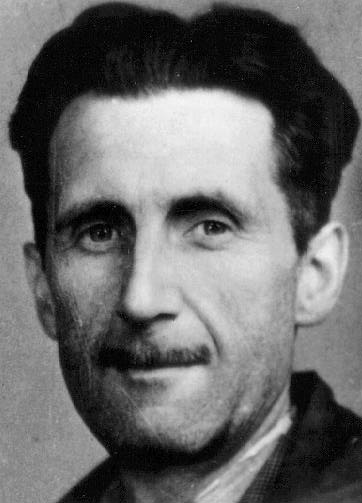
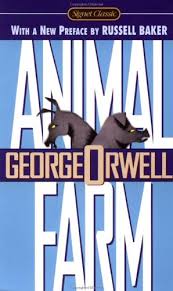
Book used: Animal Farm, George Orwell

Entry 3.5: In Class Essay (Coraline)


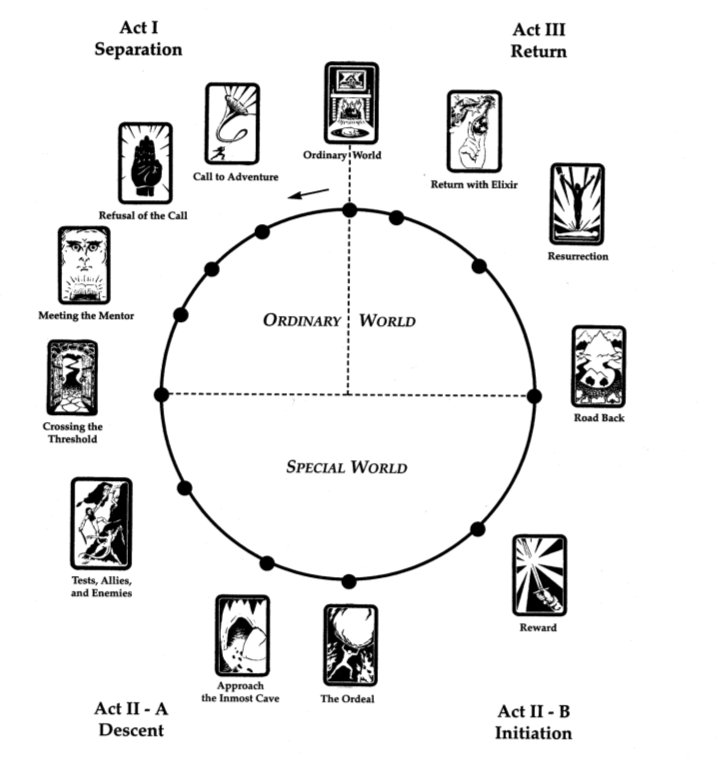
Joseph Campbell was an American scholar. He was born on March 24, 1904. One of Campbell’s most memorable works was The Hero with a Thousand Faces, where he talks about the steps heroic characters go through on their adventures. In his book Campbell describes the pattern or cycle found in literature raging from dramas to myths. The Hero’s Journey consists of twelve stages, they are the following:
The Ordinary World
The Call to Adventure
Refusal of the Call
Meeting with Mentor
Crossing the Threshold
Test, Allies, and Enemies
Approach
The Ordeal
The Reward
The Road Back
The Resurrection
Return with the Elixir
I will demonstrate Campbell’s stages by using Neil Gaiman's novel Coraline. The character I will be using is Coraline. Coraline is considered to be a heroic character in the novel.
The novel is about a young girl named Coraline. Coraline moves in to her new house, which introduces us to the first stage of Campbell's idea of the Hero’s Journey. Campbell describes The Ordinary World as a stage where the heroic character is first introduced. Campbell also described this to be a stage where the heroic character faces some sort of dilemma that is introduced in the very beginning of the story. The Ordinary World in this novel is Coraline living her normal life and moving into a new house. In the novel Coraline is described as a young girl who likes to travel, but with busy parents. Their busy personal lives prevents them to not spend time with Coraline. This isolation makes Coraline explore her new house. While exploring the house, Caroline meets new people such as Miss Spink, Miss Forcible and a crazy old man. She soon encounters a drawing room that is locked and she is warned by her mom to not enter.But, Coraline’s traveler persona gets the best of her and she goes on an adventure by unlocking the drawing room.
The Call to Adventure is described as the second stage of the Hero’s Journey. In his work, Campbell describes this stage as the stage where a solution is stirred up within the character. This is the stage is also described as a period where the hero must face change, sending the main character on a adventure. The Call to Adventure in this novel is Coraline's curiosity about the drawing room’s lock. Her curiosity gets the best of her as she unlocks it, causing her to enter the other world.
Refusal of the Call is the third stage in the Hero’s Journey. This is the stage were the heroic character fears about the unknown and wants to turn away from it but only for a short time. After this internal struggle the character is warned by another character that danger is still ahead of them. This stage in the novel can be described when Coraline arrives in the other world. While there she discovers everything about this place is opposite from the her own world. Her other mother asks Coraline to stay in the other world forever. This leads Coraline to touch her pocket where the stone was locked. In the earlier chapters, Miss Spink and Miss Forcable give the stone to Coraline as a good luck charm. In this stage the stone could represent as the symbol that danger is up head for Coraline in the other world. The other mother’s offering only cause Coraline to feel creeped out and therefore she returns to the real world.
Meeting with Mentor is the fourth stage of the Hero’s Journey. In this stage the heroic character meets up with an informative character that gives them valuable advice about the hero’s adventure. In this stage Coraline meets up with the cat, who warns her about the other world and informs her about her other mother.
Campbell describes Crossing the Threshold as a stage where the character decides to leave the ordinary world to enter to the special world. Campbell explains that this is the stage where the character acknowledges that there is in an unfair advantage by going to the special world. In the novel, this can be described when Coraline discovers that her parents are missing. Coraline then figures out that the other mother must have kidnapped them to the other world. Therefore, Coraline has to go rescue them and must return to the other world.
Test, Allies, and Enemies is a stage where the character on the journey is tested through challenges. In the novel, Coraline is tested by the other mother by telling her that she didn’t capture her parents, this is shown in pg 62 “Silly, silly, Coraline, they are fine wherever they are.” She also tests Coraline by showing her a mirror where her parents are shown living a happier life without her. The other mother test doesn’t succeed as Coaline knows that it was nothing but an illusion created by her. Coraline knows that this was a trick set up by the other mother for her to stay in the other world. In this stage Coraline acknowledges the cat to be an ally of hers.
The Approach is next stage of the Hero’s Journey. This is the stage were the character prepares to challenge the special world. This can be seen in the novel when the black cat informs Coraline about challenging the other mother. In page 65, the cat tells her to“Challenge her. There’s no guarantee she’ll play fair but her kind of thing loves games and challenges.”
The Ordeal is the stage where the character faces death in the special world. In the novel, Coraline almost experiences death. This occurs when the other mother sends the other father to capture her during Coraline's challenge with her.
The Reward is the stage where the character receives an award after almost facing death. This is the stage were Coraline gets the key from the other witch, which allow her to return to the real world.
The Road Back is another stage of the Hero’s Journey. This stage is about the hero leaving the special world. This is shown when Coraline tricks the witch by getting the keys from the other mother, which causes her to return to the normal world with her parents, the three ghosts, and the cat.
The Resurrection is the eleventh stage of the Hero’s Quest. This is where the character is tested one more time. In the novel, Coraline is tricked by the other mother as she breaks her promise and returns to the real world. The other mother comes back to the real world to get the key from Coraline.
Return with the Elixir is the final stage of the Hero’s Journey where the character returns to their normal live and is ready to face the challenge they once feared. In novel this is shown by Coraline defeating the witch and accepting who she is as a person. Coraline is therfore no longer afraid of going to school like she was during the beginning.
In conclusion, I believe that Campbell’s idea of the Hero’s Quest does help us as the reader to better understand the archetypal. Therefore, the reader understands more about the characters, than just reading the book and analyzing them through characterization. You can also see the growth of the character by using the twelve stages found in the Hero’s Journey.

Sources:

Tuesday, November 16, 2010

Entry 3.4: My Project

       For the final project I have decided to do a research paper on George Orwell novel Animal Farm. In the research paper I will cover the literary elements that we have gone over in class this semester.  The literary elements that I will be covering will consist of the following such as archetypes, theme, symbolism, and characterization. If time allows, I have considered of adding more literary elements to my paper.
       
        The steps that have already done for the final project are the following:
         1. I have already purchased the novel. I have already started  reading it.      

The steps that I will need to do to finish the project are:
          2.   Finish reading  Animal Farm.                                                                                     
                  3.   The following week I plan to go over the novel and find the literary elements in the book.
        I plan on doing this on Friday (11/26/10)
          4.    On Saturday (11/27) I will start the research paper.
          5.    The following class meeting on (12/2) I plan to countinue doing the research paper.
          6.    During that weekend (12/4 - 12/5) I plan to finish the paper. 
  7.    I plan to go over the paper on Monaday (12/6/10)
  8     Plan to revise it on Tuesday and Wedenesday (12/7/10 - 12/8/10)
          9.    By the following class meeting I will summit my paper in class.        

  Day of deadline: 12/9      

Wednesday, November 10, 2010

Entry 3.3: Final Project Ideas


My main choice for the final project is doing a research paper on George Orwell’s novel Animal Farm. Animal Farm was published in 1946. It is considered to be a science fiction fable. Animal Farm contains several literary elements that we have covered in class throughout the semester such as symbolism, archetypes, themes, and characterization.
My other ideas for the final project is doing a research paper on one of the following:

  • Nineteen Eighty- Four
  • Hansel and Gretel